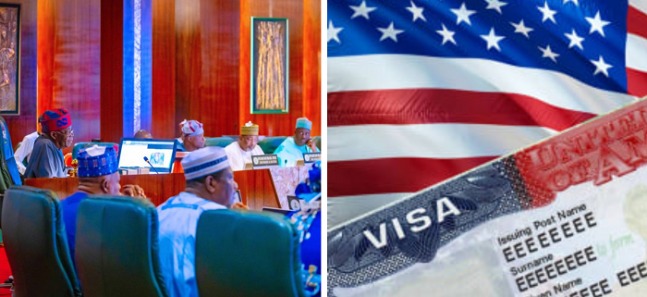
The Nigerian Federal Government has formally rejected the United States’ justification of reciprocity for its newly imposed visa restrictions. In a statement issued July 11, 2025, the Presidency emphasized that claims suggesting Nigeria stopped issuing five-year, multiple-entry visas to U.S. citizens are categorically untrue — labeling such assertions as misinformation. The government reaffirmed that it still grants these visas under existing bilateral agreements, grounded in diplomatic reciprocity .
The recent U.S. policy change, effective from July 8, has limited most non‑immigrant visas issued to Nigerians—such as B‑1/B‑2 (tourism/business), F (student), and J (exchange)—to single-entry status with only 90 days of validity . However, Nigeria clarified that this restriction applies exclusively to the new electronic visa (e‑Visa) system, not the standard visa categories. Traditional embassy-issued visas for Americans remain unaffected and continue to include five-year multi-entry validity .
A spokesperson from the presidency, Bayo Onanuga, explained that the e‑Visa—introduced to replace the visa-on-arrival protocol—was created to speed up entry for short-term tourists and business travelers. It is issued online within 48 hours and streamlines processing while eliminating in-person embassy visits. Onanuga further highlighted that while Nigeria offers this digital option to U.S. citizens, the United States has not extended similar treatment to Nigerians .
Foreign Affairs Minister Yusuf Tuggar added further context, suggesting that the U.S. decision may be linked to Nigeria’s refusal to accept deported prisoners from Venezuela. He affirmed Nigeria’s stance against external pressure in this regard, emphasizing that the country cannot be compelled to accommodate such detainees .
The Presidency emphasized its continued commitment to a respectful and cooperative relationship with Washington. Nigeria remains open to diplomatic engagement to resolve outstanding issues, stressing mutual understanding and partnership between both nations over decades .
U.S. officials maintain the restrictions are part of its global visa reciprocity regime, aiming to align visa privileges based on equivalent treatment of its citizens abroad. Nigerians now face shorter-duration, single-entry visas in what has been construed as an adjustment, not retaliation .